
DIY Solar Pirate
Research Report Series
Everything you need to know — from charging your phone during a blackout to whole-home solar backup with smart panels.
Not sure where to start? Follow these four steps — they will take you from “what do I even need?” to “I know exactly which power station to buy.”
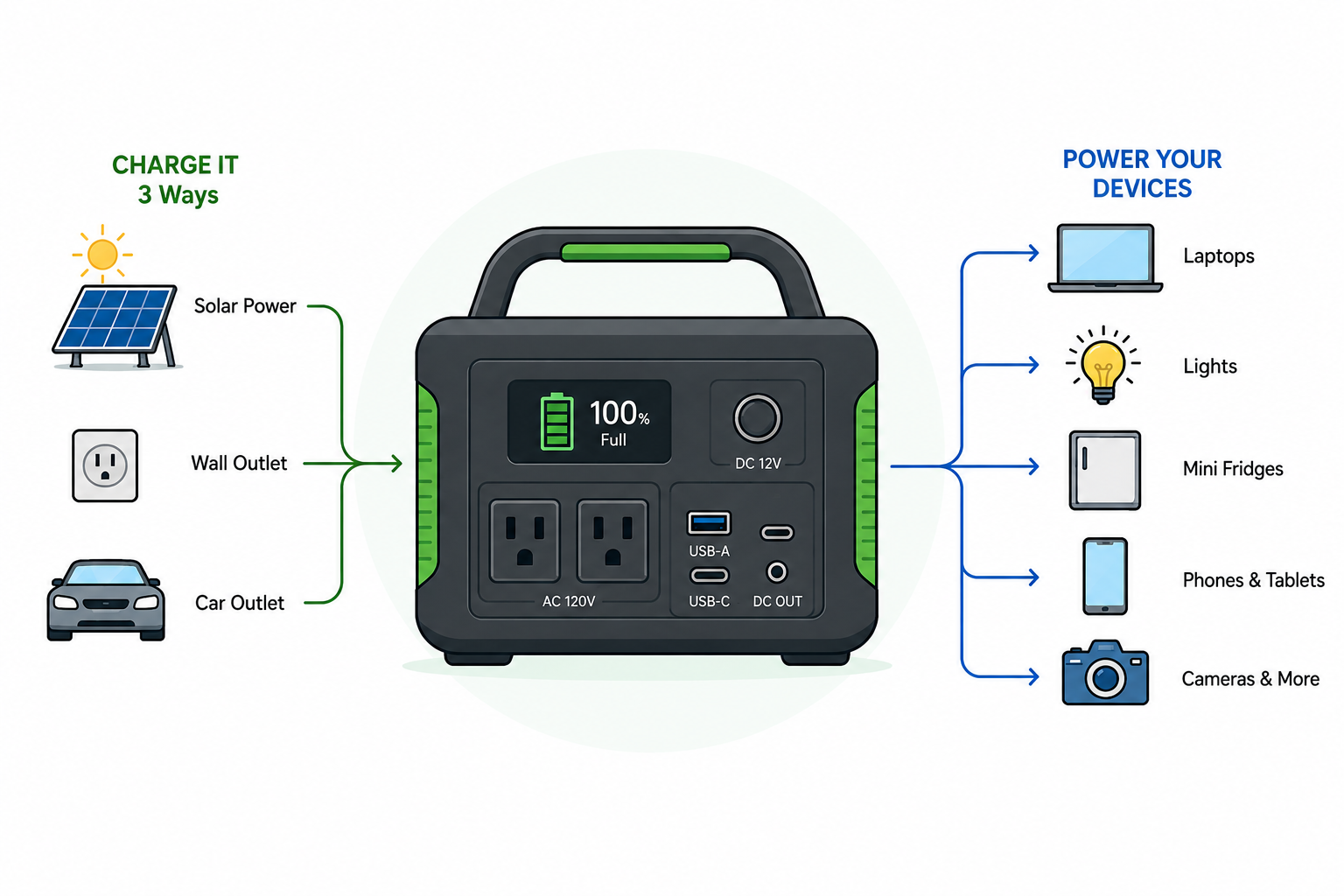
A power station (also called a portable power station or solar generator) is a large, safe, rechargeable battery with built-in AC outlets, USB ports, and solar input. Think of it as a giant version of the portable battery pack you use to charge your phone — except powerful enough to run a refrigerator, a CPAP machine, or your whole house.
You plug your devices into it exactly like you would at home. No gas. No fumes. No complicated wiring. Plug in solar panels to recharge it from the sun. Plug in your appliances. Done.
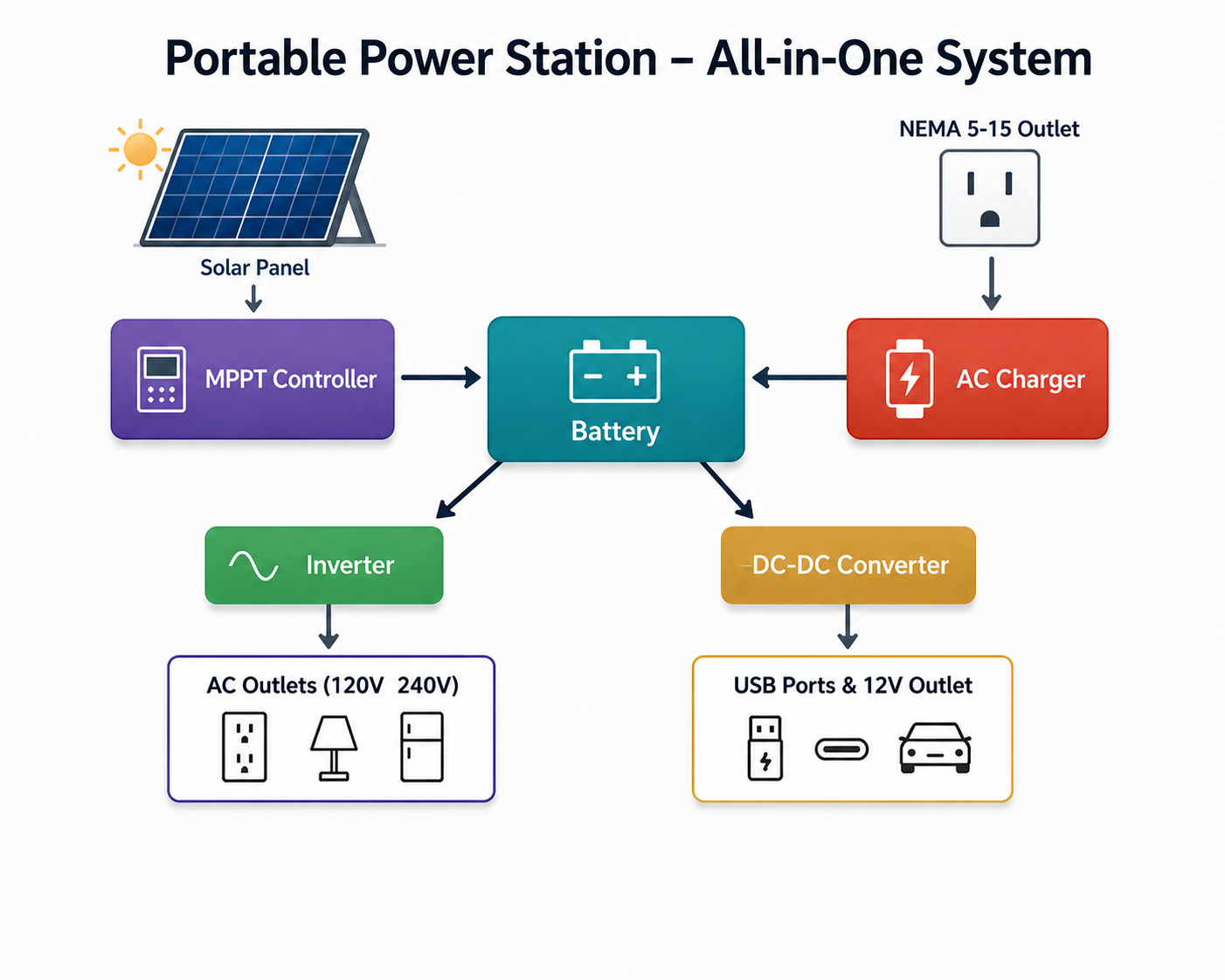
A power station is five devices in one box. Here is what is happening inside:
Want the full glossary? → Key Terms & Specs Explained
Find your scenario below. Each card tells you what to look for — so when you reach the comparison chart you will know exactly which filters to apply.
Keep your essential appliances running for 24 hours when the grid goes down: fridge, lights, phone chargers, fan, medical devices. Use our calculator to find out exactly how much battery you need — it accounts for idle draw automatically.
Power tools at a build site without grid power, or run appliances at a remote cabin for the weekend. These units are heavier but mobile — built-in wheels, carry handles, or dolly-friendly. The quiet, gas-free alternative to a generator.
Charge your phone, run a camping light, play music — or power a small fridge or CPAP machine for a weekend away. Lightweight and easy to carry is the priority. Pair with a foldable solar panel and you can stay off-grid indefinitely.
If your utility charges more during peak hours (usually late afternoon), you can charge the power station’s battery at night when rates are low, then power your home from the battery during the expensive part of the day. No solar panels required — this is pure rate arbitrage. Some power stations also integrate with a home subpanel or smart panel so the savings happen automatically. A great starting point before adding solar.
From plugging a few things into an extension cord connected to your power station + some solar panels, all the way to fully eliminating your electricity bill — there is a solar integration strategy for every budget and comfort level. You can start small and scale up gradually: solar extension cord → generator inlet → subpanel → smart inlet (like the Anker SOLIX) → smart panel → full grid independence. No need to do it all at once.
Every power station consumes a small amount of energy just to run its own inverter — even when nothing is plugged in. This is called idle draw, and it matters a lot when sizing a unit for 24-hour emergency use. A unit rated at 2,000 Wh might only deliver 1,600–1,800 Wh of useful energy after accounting for idle losses, depending on the model.
Our Power Usage Calculator already accounts for this. When your results carry over to the Comparison Chart, the Battery Capacity for 24h filter is the idle-adjusted number — so you are always comparing real-world capacity, not just the spec-sheet number.
These reference pages are optional. You do not need them to pick a great power station. But if you want to fully understand the specs on the comparison chart, or learn why solar wiring matters, these are your resources.